The story
Traveler Intelligence · Chisinau, Moldova · Verified 13 September 2026
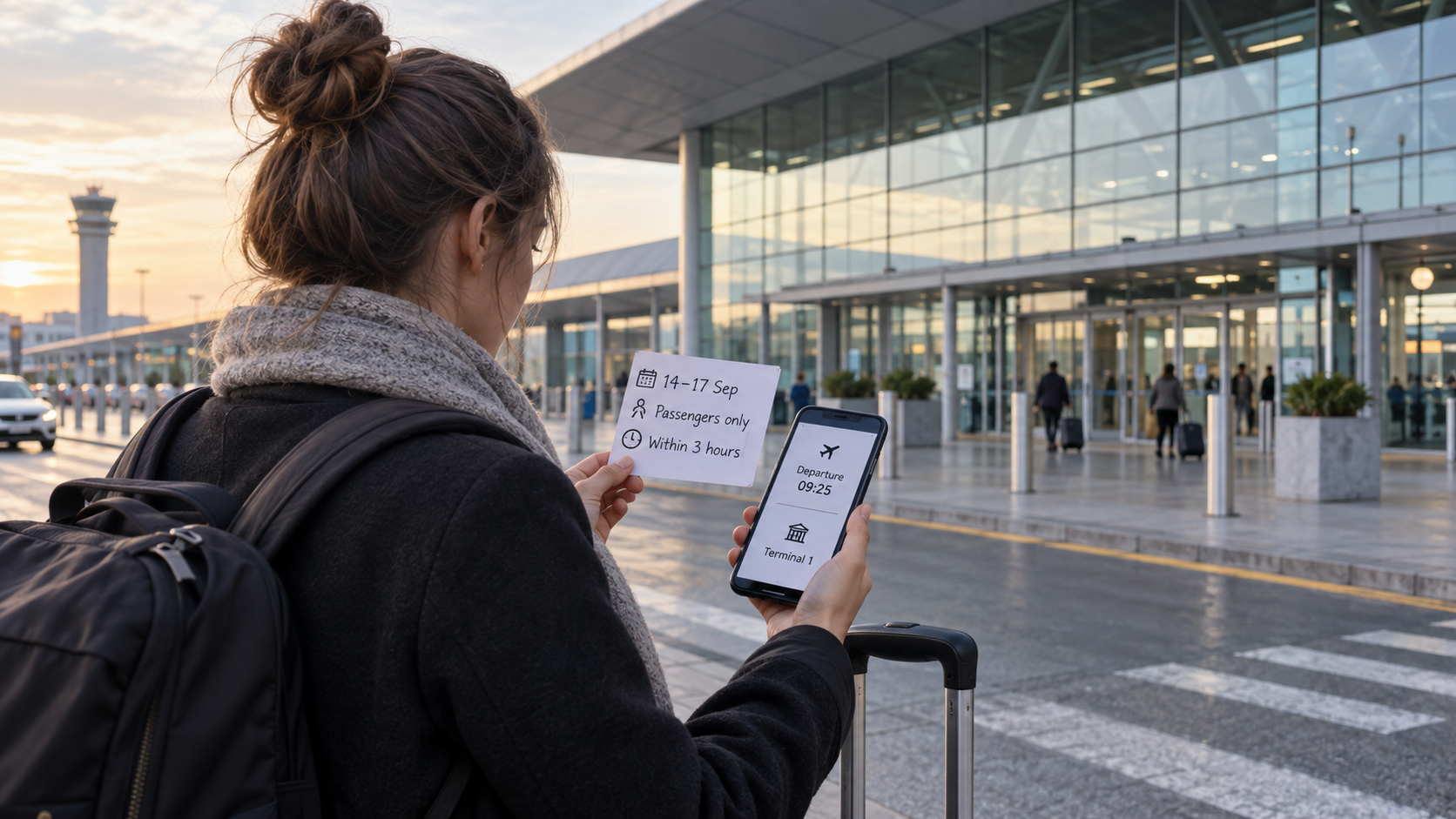
Chisinau International Airport is scheduled to remain open from 14 to 17 September, but its terminal will not operate as usual. The airport and Moldova’s Border Police say that only passengers, airport staff and aircraft crew may enter, and that passengers may go inside no more than three hours before their scheduled departure. Bring travel documents and a flight confirmation; companions should plan to say goodbye outside.
The measure is a temporary passenger-flow control connected with Hasidic-pilgrimage departures. It is not a flight suspension, a border closure or a rule that applies across Moldova. The useful question for an ordinary passenger is narrower: can the airport transfer, luggage handoff and any assistance request work without the usual freedom to arrive early or bring someone into the terminal?
The rule is simple; the handoff is not
The Border Police notice and the airport notice set out the same operational boundary: between 14 and 17 September, terminal entry is for passengers, staff and crew only; passengers are admitted no earlier than three hours before their scheduled departure after presenting travel documents and flight confirmation.
That makes an early arrival with a companion a poor default plan. It also means a car, taxi or coach should be treated as a drop-off arrangement rather than a place where a non-passenger can expect to wait indoors. The agencies have not published a universal queue forecast, a maximum security-wait time, a designated companion area, or a public exception list for delayed flights, unaccompanied children or travellers requiring mobility assistance.
Sources: Moldova Border Police and Chisinau International Airport, published 11 September and checked 13 September 2026. “No public exception process found” describes the notices reviewed, not an assertion that no assistance will be available.
Do not turn a three-hour limit into a queue prediction
There is a reasonable case for the restriction. A short, document-based entry rule can make a concentrated departure period easier to manage, and passengers who meet the conditions may experience only a more controlled arrival. The airport asks travellers to check their flight status and prepare documents in advance.
The hidden cost is lost flexibility. A family helping with bags, an older traveller, a passenger relying on a coach, or someone whose airline changes a departure time may need a more deliberate plan than a solo traveller with a small suitcase. The policy’s practical edge is not evidence that everyone will face a long delay. Neither the airport nor Border Police has published a queue-time guarantee, so a precise extra-time recommendation would be made up.
Older public traveller discussions about Chisinau often focus on security queues and road timing, but they predate this four-day arrangement and are self-selected. They are useful only as a reminder to check same-day conditions—not as a forecast. The Border Police’s broader 7–17 September advice asks travellers to verify documents, review crossing conditions and plan routes in advance; it does not assign an airport wait time.
A safer plan for a fixed departure
First, check the airline’s flight status and its own check-in or baggage instructions on the day. Then calculate the terminal-entry window from the scheduled departure, not from the time you would normally leave home. Carry the documents the airport names, keep transfer arrangements reversible, and separate any companion or luggage-assistance handoff from terminal entry.
For a traveller who needs wheelchair assistance, is travelling with a minor, has an unusual connection or expects a long-distance coach arrival, the unanswered question matters more than the headline. Contact the airline and airport before leaving and ask how the passenger-only rule changes the handoff. An individual answer from the operator is more reliable than assuming the normal terminal routine still applies.
The restriction runs for four days. It should not recast every Moldova trip as disrupted—but on an affected departure day, treating access to the building as a timed, passenger-only step is the difference between a manageable airport plan and an avoidable surprise.
Sources and evidence status
> Independent editorial coverage. No affiliate links, paid placement or commercial partnership.
>
> This is not immigration or legal advice: use official Moldova guidance for the passport and purpose of travel in question.