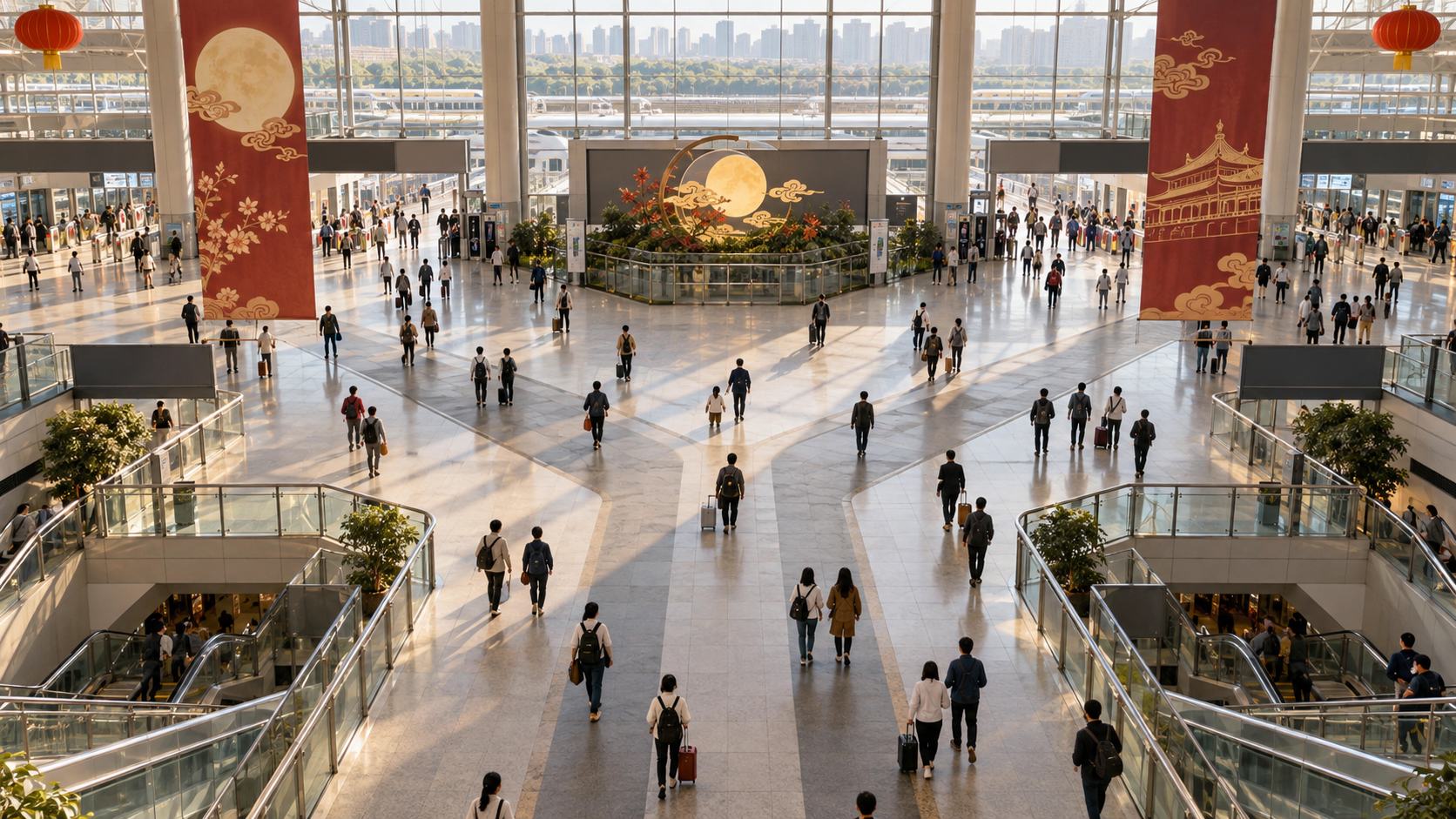
The story
China's official forecasts point to pressure at border crossings on 25 and 27 September and 1 and 4 October 2026. They identify planning risks, not a promised queue time or a nationwide shutdown.
Last verified: 25 September 2026 · Under Pressure · China
For a visitor with a fixed connection, the question is whether it meets a forecast peak at the actual port or station. The National Immigration Administration (NIA) expects the strongest cross-border days on 25 and 27 September and 1 and 4 October. Mid-Autumn runs 25–27 September; National Day runs 1–7 October. Other days are not guaranteed quiet.
What the border forecast measures
NIA projects about 2.25 million inbound and outbound passenger trips daily during Mid-Autumn and 2.15 million during National Day, with a possible day above 2.4 million. These are national border-inspection flows, not foreign-tourist counts, queue times or domestic rail figures. Check the notice for your actual airport or land port.
NIA says Chinese citizens' inspection queues should not exceed 30 minutes under its holiday arrangements. That is not a foreign-passport guarantee and excludes check-in, security, baggage and onward travel. Added staffing may ease pressure, so a peak forecast does not mean every traveler will wait longer.

Shanghai rail is a separate signal
The Shanghai Municipal Government expects 8.53 million departures from city stations during 23 September–8 October: about 770,000 on 25 September and 800,000 on 1 October. Operators plan 146 extra train pairs. This is a Shanghai forecast over a different period, not a national measure or proof that a specific train is full.
For a multi-city trip, check the border crossing, booked train and attraction reservations separately. A one-city stay may face less connection risk than a border crossing followed by a train on the same peak date.
Build slack around the irreversible step
If plans can move, compare peak dates with other entry or departure days. Otherwise, protect the hardest connection to replace: verify the station and port and the operator's latest schedule. The Ministry of Culture and Tourism advises checking weather, traffic, attraction opening and reservation rules.
Neither source gives a universal transfer buffer: national border totals cannot predict a foreign visitor's queue, and Shanghai departures cannot establish ticket availability elsewhere. Leave flexibility where one missed connection would disrupt the trip, and recheck local notices close to travel.
Sources and evidence status
> Independent editorial coverage. No affiliate links, paid placement or commercial partnership.
>
> This is not immigration or legal advice: use official Chinese entry and border guidance for the passport and purpose of travel in question.